

Stakeholder Mapping
Why Stakeholder Mapping matters
Every strategy, project, or change initiative lives or dies inside a political system. However well-conceived the plan, however robust the business case, success depends on a collection of people (both inside and outside the organisation) who each have their own views, interests, and degrees of power to help or hinder what you are trying to do.
Most leaders know this intuitively. Yet when it comes to implementation, many still behave as though a sound plan and clear authority will be enough. They are then surprised when a peer derails the initiative, an executive sponsor loses interest at a critical moment, or a business unit they had barely considered turns out to hold a decisive vote.
Culture eats strategy for breakfast
This phrase, widely attributed to Peter Drucker, captures something crucial. The intangible, collective aspects of an organisation (its culture, the stories people tell about how things really work, the symbolic weight attached to decisions and behaviours) have the power to either reinforce or dismantle the concrete artefacts of strategy: the plans, the systems, the delegation structures.
Power relationships and political dynamics are among the most important of those intangibles. If you want your strategy to actually deliver, you cannot treat politics as noise to be tuned out. It is the terrain you are operating on.
The cost of not doing this
Leaders who skip or rush stakeholder analysis tend to experience a familiar set of problems:
- Late-surfacing opposition: resistance that was entirely foreseeable, had anyone thought to look.
- Sponsor drift: a key executive who was notionally supportive turns out to be passive, and their silence is read as quiet disapproval.
- Wasted influence: energy spent persuading people who were already on-side, while the genuinely pivotal stakeholder remains untouched.
- Avoidable surprises: a blocking decision from a part of the organisation nobody thought to engage.
The payoff
Stakeholder mapping is a deliberate practice for making this invisible terrain visible. Done well, it:
- Clarifies where your effort will actually matter: so you invest influence where it changes outcomes, not where it feels comfortable.
- Surfaces your blind spots: the people you have unconsciously discounted, and the assumptions you are making about what others think.
- Converts political intuition into a plan: moving from "I have a bad feeling about this" to specific, authorised actions you can take.
- Gives you a shared language with your team for talking about power and positioning without it feeling grubby or Machiavellian.
The practice is not about manipulation. It is about taking the politics of your organisation seriously enough to engage with it honestly — understanding what other people actually want, and planning how to move forward in a way that works for them as well as for you.
What is Stakeholder Mapping
Stakeholder mapping is a structured way of thinking about the people who have a stake in your outcome; how influential they are, where they currently stand, and what it would take to move them.
At its core, it is a two-dimensional map you plot people onto:
- The vertical axis captures how influential each stakeholder is on the success or failure of your project or position. High on the axis means they can meaningfully shape the outcome; low means they cannot.
- The horizontal axis captures their energy and intent towards what you are trying to do.
- Unaware: Doesn't know about your position or project. Has no perspective.
- Aware: Has heard about your position or project. Probably has a perspective.
- Mobilised: Definitely has a perspective and is moving into action (either to support it or to counter it)
- In Action: Has a plan and is executing those decisions and actions. Probably enlisting the support of others to their perspective.The centre represents being unaware. Moving right means increasing support for you. Moving left means increasing opposition to you.
Seeing them plotted together reveals the shape of your political landscape: whether you have headwinds or tailwinds, where your leverage lies, and where your greatest risks sit.
Two POINTS TO KEEP IN MIND
First: people's positions are not fixed. Stakeholder mapping only earns its keep if you believe people can change their position. If you approach the map fatalistically, it just becomes an elaborate way of cataloguing your defeats.
Second: you usually do not know what others actually think. The most common mistake in this work is taking perspectives rather than seeking them. People are more often surprised by their stakeholders than correct about them. The map is as much a prompt to go and ask as it is an analytical tool.
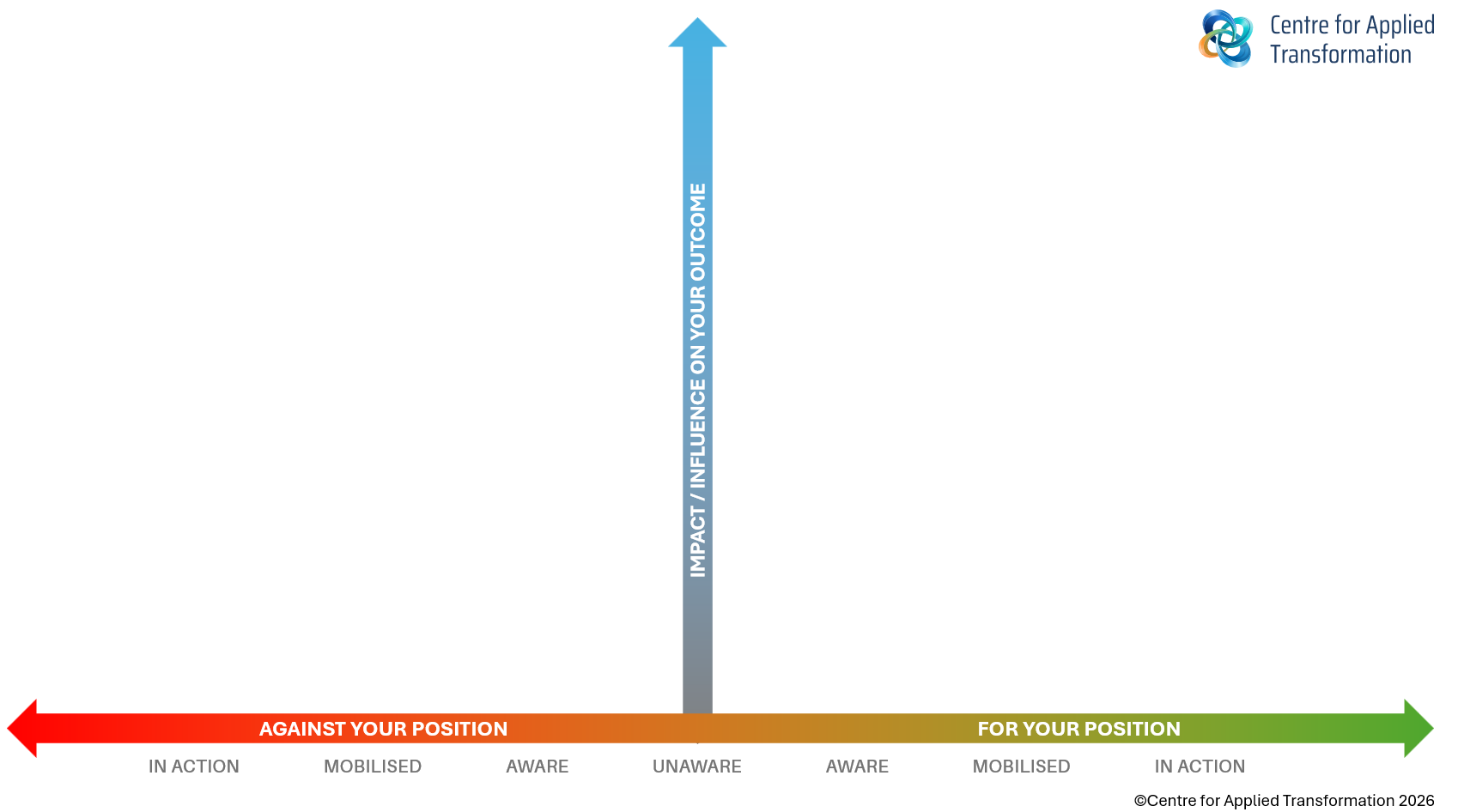
Step 1: Create a grid to plot your stakeholders
The vertical axis indicates how influential the person or group is in the organisational system on the success or failure of your position or project.
The horizontal axis indicates increasing energy and action by your stakeholders; aligned intent to the right and counter to the left. The horizontal centre line (the vertical axis) indicates they are unaware of your project, intent, or decision. Each step to the right is a step of further increasing 'pro' intent or action; to the left indicates increasing 'anti' sentiment or action
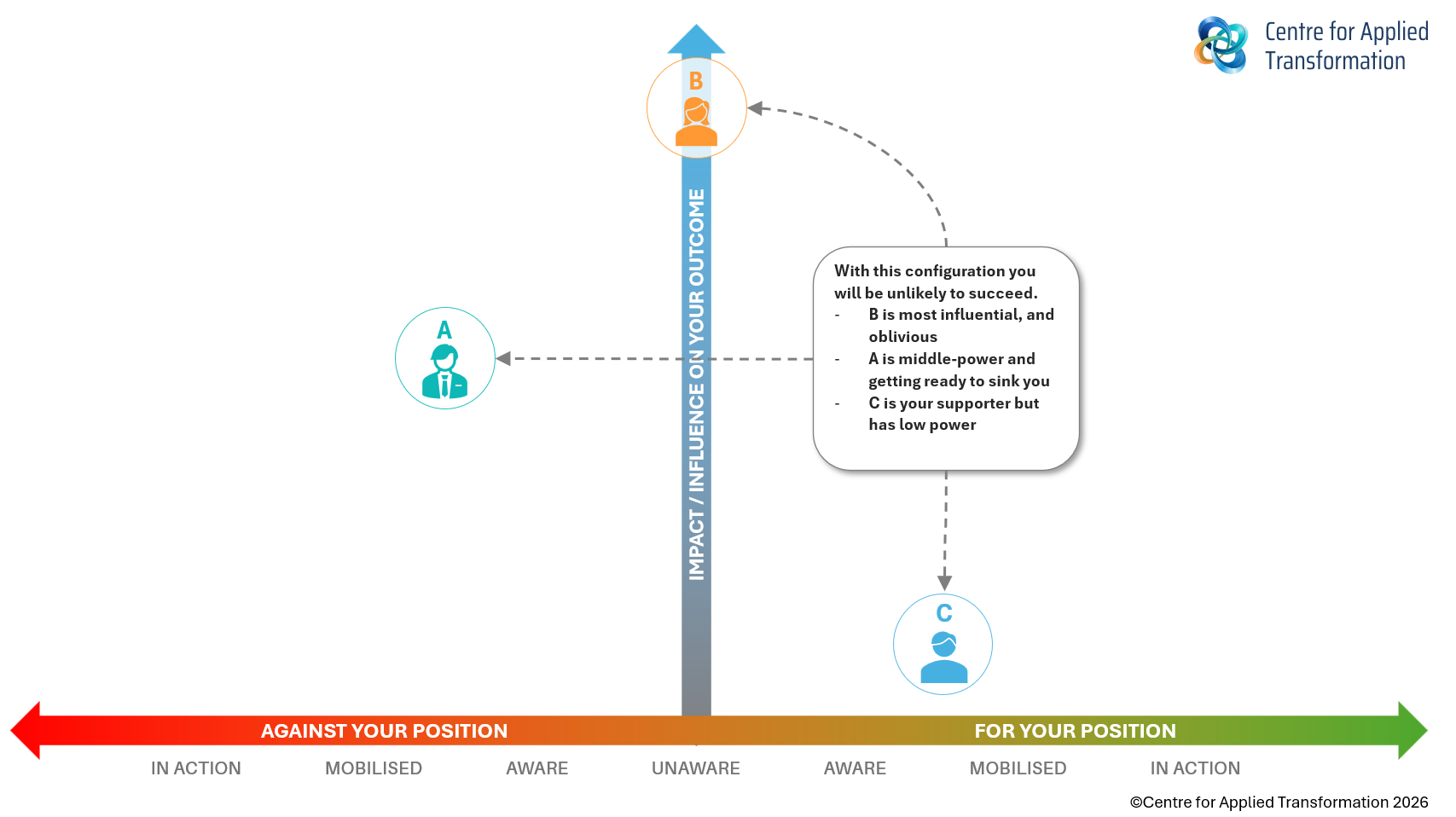
Step 2: Plot your stakeholders' starting positions
You could 'take their perspectives' (i.e. assume you know what they are thinking) or, better still, you could 'seek their perspectives' and actually ask them what they think (it is remarkable how often people believe they know what others think or feel, but have not actually checked this out... to their detriment)
In this example, A is mobilised against your position and quite influential; B is very influential, but unaware; C knows what you want to do, but has little influence.
In this example, you are facing considerable political headwinds
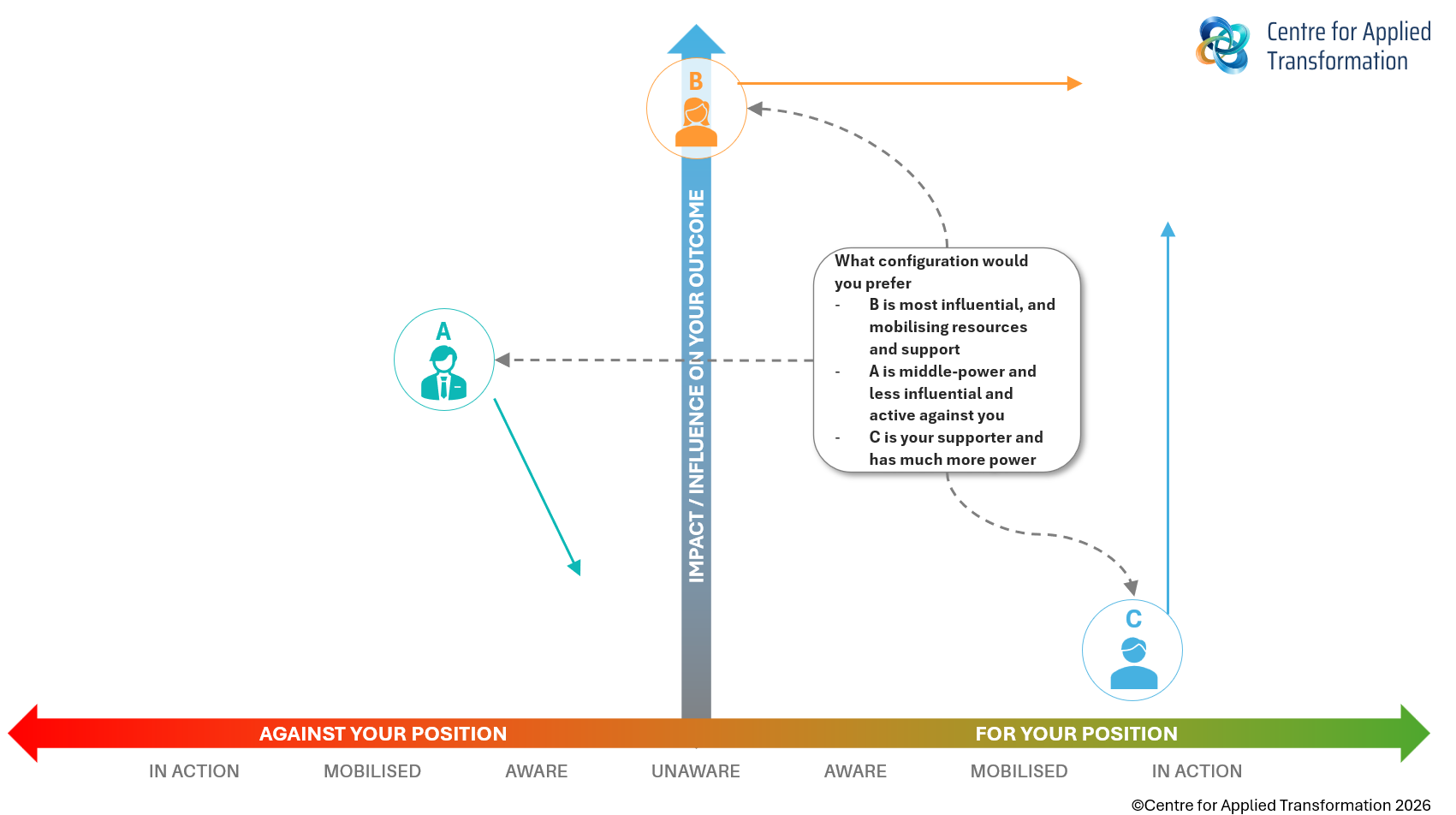
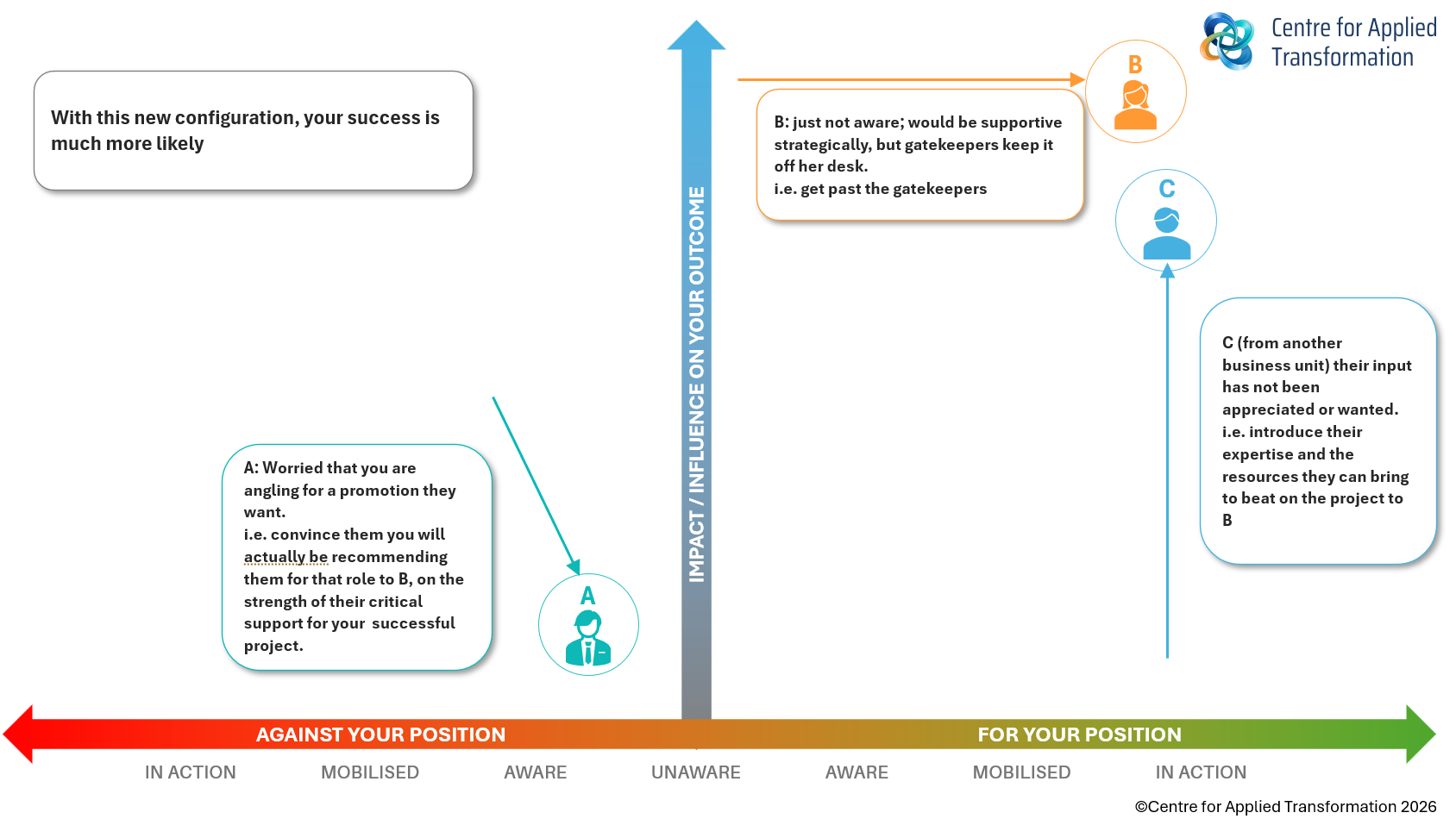
Step 3: Where would you like to reposition your stakeholders?
- A has less influence and is not working against your outcome...
- B becomes aware of what you are trying to do and the benefits, and becomes strong a supporter, and takes some action
- C also moves into action and has more influence in the process or decision-making
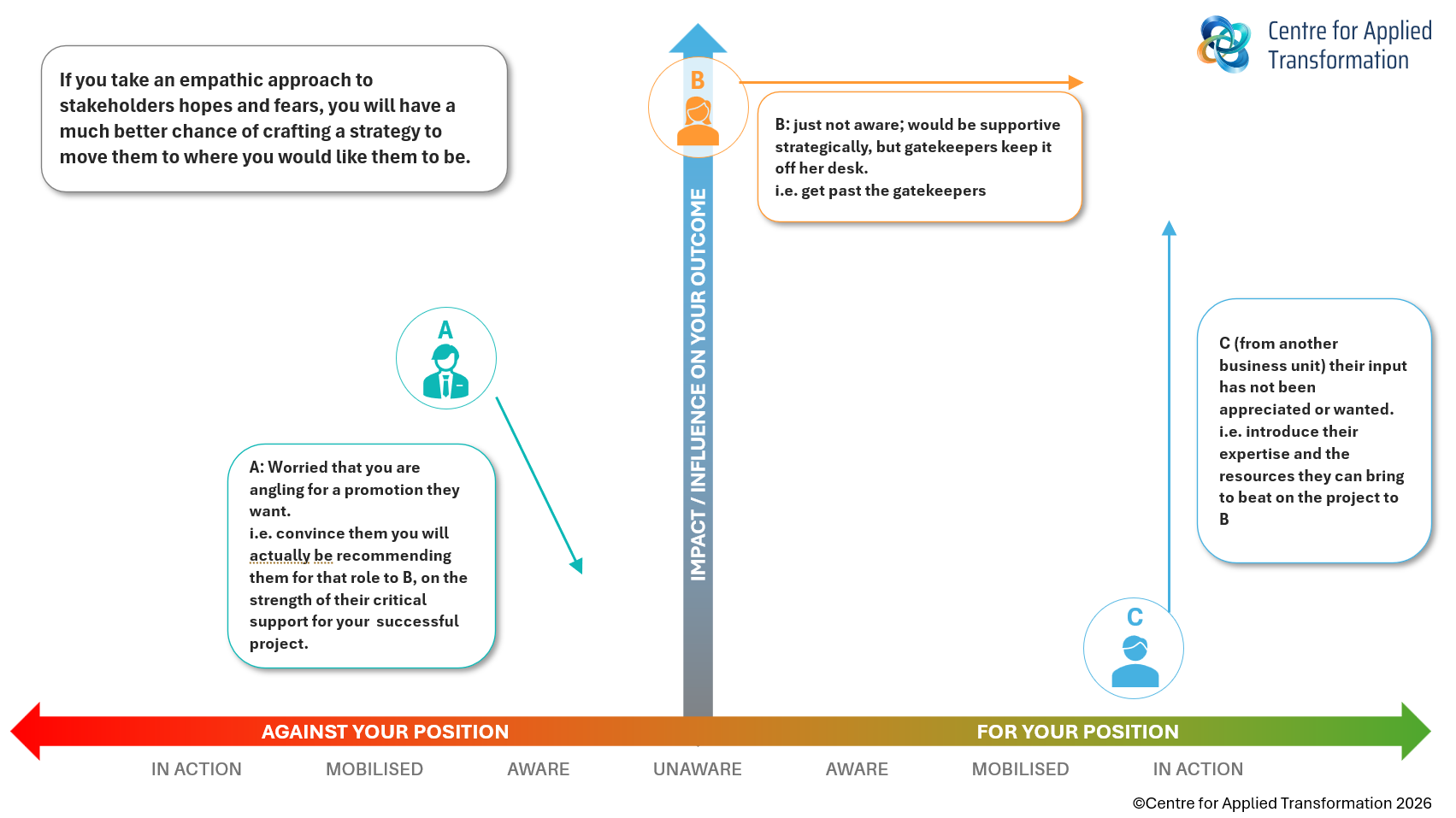
Step 4: Plan your actions with respect to each stakeholder
This is where you strategise concrete actions that you are authorised to take that will hopefully reposition your stakeholders' perspectives and actions. For example:
A: Recognise they see you as a rival and convince them that you do not want to follow their chosen path; that you do not want the promotion they want very badly
B: Realise they are being 'gatekept' and find a way to get the face time to pitch your idea and its benefits
C: Is from a business unit seen as irrelevant and unhelpful; educate people on C's resources, skills and how they can help not only this project but also more widely
Step 5: Where are they now?
Repeat until you get what you need or the situation changes.