

Emotional Acuity
Those who cannot read their inner world end up driven by it.
Those who can read it gain clarity, control and respect.
Why Emotional Acuity matters
If we do not practice the skill of seeing what is happening inside ourselves, we are running on autopilot. That's fine when the going is good, but under chronic stress, threat, or when stakes are high, we often become the worst version of ourselves. Over time, this can become our default mode. For leaders, the consequences can be highly damaging to your health, reputation, effectiveness, and the broader organisation.
A common coping mechanism is to try and ignore or repress one's emotions, but that has a long list of damaging effects; physically, psychologically, and socially. The healthier and more skilful approach is to let the emotions emerge, notice them, appreciate them as data to make sense of, then let them pass through you.
In short, when you can read your own emotions with precision, you gain choice and stability. You become harder to provoke, slower to rush, and quicker to understand what the moment requires.
Great leadership begins here.
What is Emotional Acuity?
Emotional acuity is your ability to notice what you are feeling, name it accurately, and use that information to guide your behaviour. It is not about being overly sensitive or sentimental. It is about being conscious.
It rests on a simple mechanism. Your body signals first, your emotions interpret those signals, and your mind creates a story to explain them. Importantly, without a concept (eg. an emotional label) to map the emotion to, it's unintelligible static. That static increases confusion alongside erratic thoughts and behaviours.
However, if you train yourself to notice the physical and emotional signals early, then engage with the feeling, name it, and discover its source, you can interrupt the old reactive story and choose better responses instead.
This is learnable. It improves with practice in the same way attention or fitness improves. The more precise your self-awareness and emotional vocabulary become, the more options you have in any difficult moment.
How to Build Your Emotional Acuity
You build this skill by slowing down your reactions and paying close attention to your internal signals.
The goal is simple: understand what you feel and why you feel it, before you act on it.
Use this short daily practice.
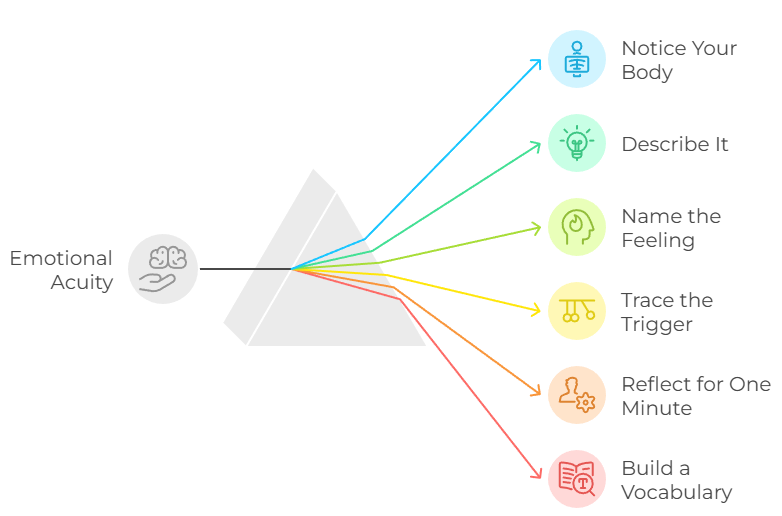
Step 1. Notice your body
Every emotion begins as a sensation. Tight jaw, heavy chest, warm face, quick breath. Do not analyse it. Just observe it.
Ask: Where in my body is this happening?
Step 2. Describe it
Describe the emotion like an object. Shape, pressure, colour, temperature. This lets you step into observer mode and unhook, even if just a little, and you might already find the feeling loosening its grip.
Step 3. Name the feeling
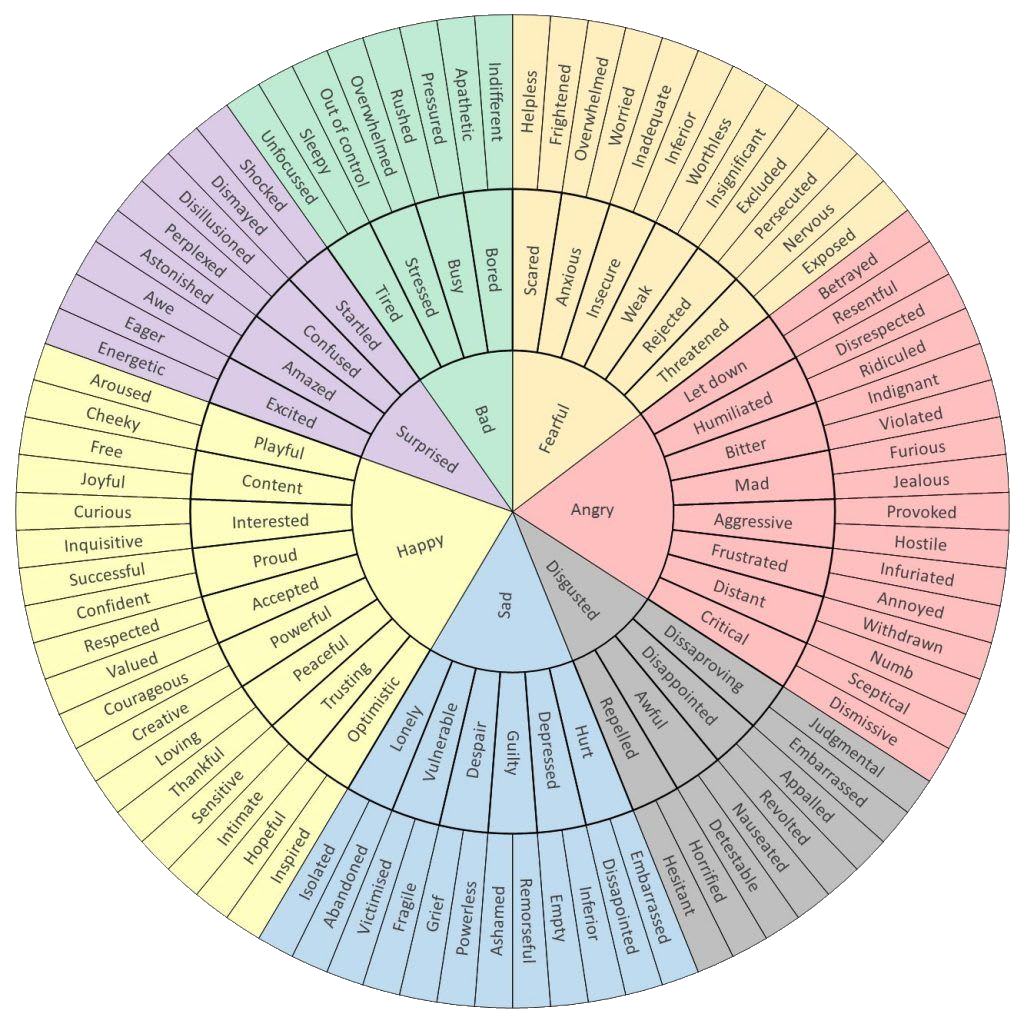
Step 4. Trace the Trigger
- Investigate what set this off. Not in a judgemental way. Simply map cause and effect. A person, a tone, a deadline, an old memory, a threat to status - basically anything that consistently 'pushes your buttons'.
- Ask yourself why? "Why did this emotion surge in me?" or "Can anyone evoke this reaction, or only specific people?". Understanding why your triggers are what they are is key to managing your reactions next time. Plus, they are rich with learnings about opportunities for personal growth.
Step 5. Reflect for one minute
Ask: what is the smallest useful action now? Do I need to pause, speak, wait, ask, or step back. These small actions compound over time building both stability and flexibility.
Step 6. Build a vocabulary
Choose an emotion category each week. Learn a few specific words. Imagine feeling each one. Notice where it appears in your body and how it behaves. This sharpens your perception in real time.
The payoff is simple: when you are more in touch with your inner life, you have more freedom in how you respond to the world outside. You become clearer, calmer, and more effective under pressure. That is the foundation of good leadership.