

Empathic Listening
Why Empathic Listening matters
What is Empathic Listening?
Before we get to empathic listening, we first need to clarify that this is not the same as active listening.
Active listening focuses on accurately hearing, acknowledging, and reflecting back the content of what someone is saying.
However, words are only a small fraction of what people are broadcasting. Tone, emotion, rhythm, intention, body language, and even what's not said, paint a much richer picture. In empathic listening, you pay attention to all of it, because you're not just interested in the story - you're trying to understand the story behind the story.
Empathic listening is the meta-skill of taking in the all the signals coming from another person. It can be broken down in a series of micro-skills, each of which can be isolated and practiced individually. However, the real power emerges when you're able to combine them.
It rests on three pillars:
- Presence means you are fully here.
- Validation means you show the person you understand what they are expressing.
- Curiosity means you explore their experience without assumption or judgment.
It is the practice of placing your awareness on another person without the noise of your ego, your opinions or your urge to fix.
How to do it
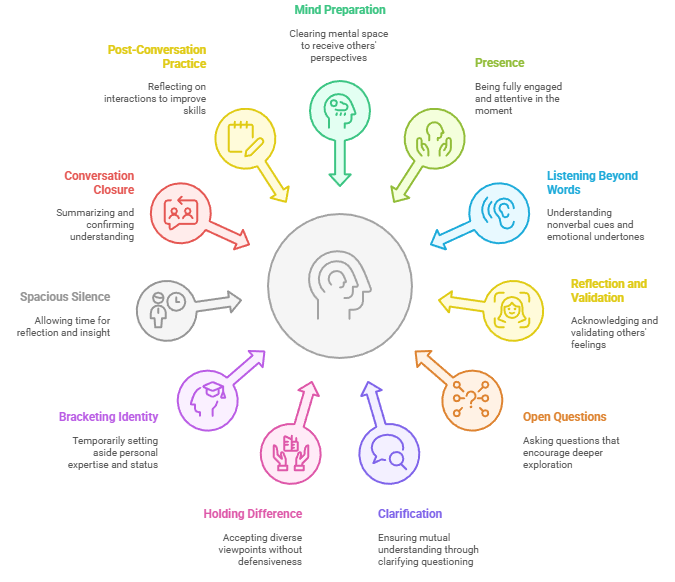
1. Prepare Your Mind
Often difficult conversations are doomed before they begin because at one person has already made up their mind.
Take ten seconds to check yourself. Notice any assumptions, resentment or pressure you bring in. Set them aside like items on a table. This creates mental space to allow in the other person's world.
Ask yourself:
• What attitude and assumptions am I walking in with?
• What outcome am I attached to?
• What part of me wants to defend or prove something?
This centering shifts the conversation before a word is spoken.
Be Fully Present
Presence is the raw material of empathy. Humans detect attention with great accuracy, and they open up only when they feel it.
- Put away distractions.
- Slow your breath.
- Face the person and relax your posture.
- Give them the clear signal that you are fully here with them and paying attention.
Presence also means noticing what happens inside you while they talk. You observe your reactions lightly and avoid acting on them. This keeps you from interrupting or drifting into internal arguments.
Listen Beyond the Words
As we mentioned, words are a thin slice of human communication. Tune into
- tone
- rhythm
- tension
- hesitations
- the emotional charge beneath statements.
- what is said
- what is implied
- what is avoided
- This gives you the full picture.
Questions to guide your attention:
• What feelings seem alive in them?
• What shifts when they speak about certain topics?
• What am I sensing in myself as I listen?
Noticing these layers helps you understand the real message.
Accurately Reflect and Validate
People are calmer and clearer when they feel understood. A simple reflection is often enough. Use their language. Keep it short.
For example: “You felt overwhelmed by the deadline” or “Sounds like that meeting left you frustrated.”
This shows you are tracking their experience with care, not just repeating their words.
Importantly, validation does not require agreement. It shows you see the emotion as legitimate. When people feel seen, they stop defending, start disclosing, and the real honest conversations can begin.
Ask Open, Clear Questions
Curiosity is the engine of empathic listening. Ask questions that make space instead of narrowing it.
Useful prompts:
• Can you say more about that?
• What matters most to you in this situation?
• What are you feeling underneath the frustration?
• What do you need right now?
These questions help the speaker uncover meaning step by step. They also slow down reactive patterns.
Clarify Meaning
Never assume you fully understand the person’s interpretation of events. Check it gently. For example: “When you say you felt dismissed, what did that mean for you” or “Help me understand what felt unfair.”
Clarification keeps the conversation honest. It prevents decisions built on assumptions and mixed messages.
Hold Difference Without Defence
The moment we feel blamed, judged or contradicted, our body prepares for a fight. Notice this. Breathe. Stay open and avoid black-and-white positions. You can explore someone’s criticism without collapsing into defensiveness or dismissing their perspective.
If someone says, "No. You're wrong"
Try: “Help me understand how you see it” or “Tell me what I am missing.”
This single shift transforms conflict into information. It is a rare and powerful interpersonal skill.
Temporarily Set Aside Your Worldview and Identity (Bracketing)
Your expertise, role and past success create an identity. When challenged, identity defends itself. Empathic listening requires you to put that identity on the shelf for a moment. This does not weaken you. It strengthens your clarity.
For example, think of how an accountant might respond to “You got all the figures wrong in my accounting, you don’t seem to know much about my accounts”. The accountant is likely to respond defensively. But imagine how the speaker would receive the following response from the accountant who brackets the defence of their accounting expertise and responds with - “Oh, I didn’t realise I screwed up, please let me know what’s wrong here…"
By not becoming defensive and inviting more inquiry, trust is developed.
Offer Spacious Silence
Silence gives people room to think. Most of us rush to fill it because silence feels uncomfortable. Train yourself to hold a few extra seconds. Let the other person settle, feel, consider and continue. Many insights only emerge when the listener gives space.
Close the Conversation With Care
Before finishing, summarise with any or all of the following:
• Here is what I heard
• Here is what seemed important
• Here is what you want next
Confirm it with them. This last step shows you have been with them the whole way through.
11. Build a Post-Conversation Practice
Empathic listening improves with reflection. After important conversations, ask yourself:
• When did I feel pulled off centre?
• What reaction surprised me?
• Which skills did I practice?
• Where did I lose curiosity?
• Which skills do I want to practice next time?
This turns every interaction into training, and over time, you will see the compounding impact they have.