
Case Study:
Creating a Coherent Operating Model for Transport Infrastructure
Industry
Transport Infrastructure
Focus
Structure, System, Leadership
Impact
- Restored within the executive team
- Clearer accountability leadership
- Reduced meeting load
- Shared language and principles adopted organisation-wide
- Sustained behaviour change
Executive Summary
The client, a major transport infrastructure organisation, faced significant complexity, short‑term decision cycles, and unclear cross‑functional accountabilities following a restructure and a surge in large‑scale projects.
C4AT implemented its Organisational Operating Model to bring clarity to roles, decision rights, and ways of working, integrating mindset, system, culture, and behaviour dimensions.
A two‑tiered, leader‑led development program equipped executives and their direct reports with shared language, principles, and practices to lift capability, reduce reactivity, and strengthen collaboration.
The work delivered clearer accountability, improved organisational coherence, and a sustained shift in leadership behaviour, enabling the organisation to address real constraints and operate more effectively in a complex stakeholder environment.
The Challenge
The client is a large, complex organization with significant influence on and relationships with external stakeholders. They provide key infrastructure for the capital city and the state, and given their context and environment, their size of operations and impact into the future, they are a significant and complex business, with high-level decisions that will impact over decades.
However, because of electoral cycles, many plans and decisions in the organisation were quite short term, and having at least one shadow organisation in government rendered decision making complex and over-wrought. Most people were struggling to work at the right level, to address the problems they needed to solve, and to effectively organise the work that needed to be done.
There had been a recent restructure and reorganisation of roles which required a high degree of cross-functional collaboration across the business. As well, there was a significant increase in number and size of big-build projects and many contractors, joint-ventures, alliances, all of which added massively to the complexity of the situation.
The short-term focus was not allowing the longer-term systemic issues to be raised or resolved which was resulting in greater cost and operational inefficiencies being built into the infrastructure, systems-of-work, and ways of working.
Verena and Brent were contacted to address the lack of clarity, accountability and ways of working in the new structure. This was not a restructure request.
Our Approach
Our initial remit was to bring clarity to the operating model within the business, i.e. how to specify, define accountability and ways of working cross functionally. We knew that a ‘systems-only’ approach would not be sufficient for the task.
We proposed and implemented C4AT’s Organisational Operating Model (OOM). The OOM is the foundation of a business operating system, and is designed to enable effectiveness, sustainable performance, and strategic coherence.
The OOM addresses both the inputs and the outputs required to deliver organisational performance.
Context and Purpose of the OOM
The OOM is a business operating system designed for organisational and environmental complexity. The OOM considers both the inputs and the outputs required to deliver organisational coherence.Our initial remit was to bring clarity to the operating model within the business, i.e. how to specify, define accountability and ways of working cross functionally. We knew that a ‘systems-only’ approach would not be sufficient for the task.
We proposed and implemented C4AT’s Organisational Operating Model (OOM). The OOM is the foundation of a business operating system, and is designed to enable effectiveness, sustainable performance, and strategic coherence.
The OOM addresses both the inputs and the outputs required to deliver organisational performance.
Inputs: Dimensions and Subdimensions
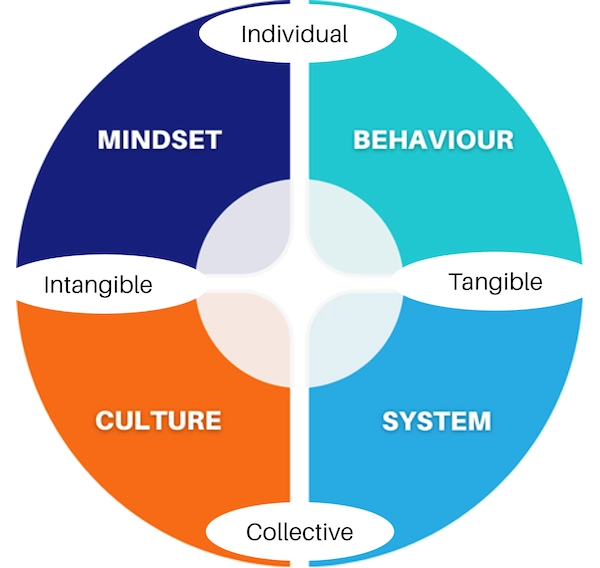
Organisational effectiveness, sustainability, and coherence requires the development of both individuals and the collective in both tangible and intangible Dimensions and Subdimensions
To deliver Organisational Outcomes in VUCA environments people need to integrate the multiple perspectives of Mindset, Behaviour, Culture, and System
Organisations often focus heavily on structure and systems, overlooking the importance of Mindset, Behaviour, and Culture. The OOM balances all dimensions to prevent common pitfalls, such as power and politics, eroded trust, and disengagement. By integrating these dimensions, the OOM provides alignment on how to build a resilient, high-performing organisation, equipped to navigate complex challenges
Outputs: Organisational Outcomes
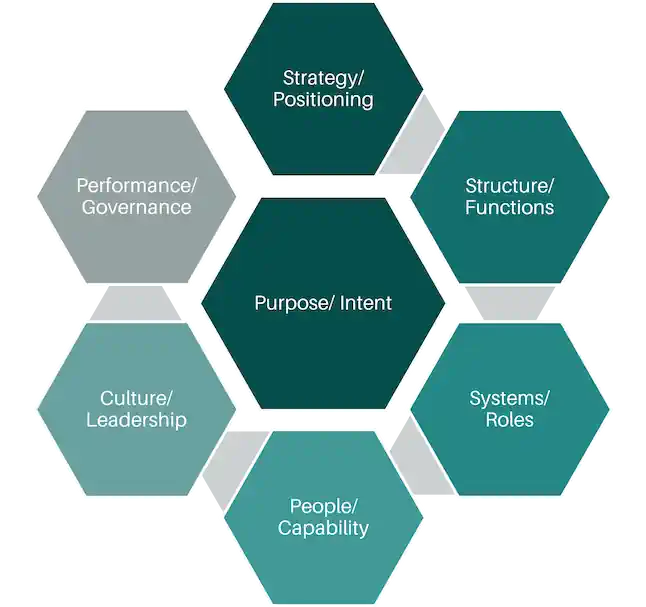
A set of outcomes, decisions, facilitated by perspectives, frameworks, and processes that enable an organisation to operate in an intentional way to meet its purpose.
All the Organisational Outcomes contribute to sustainable business and must be iterated with a regular rhythm for organisational coherence.
All outcomes are present at all levels of the business but are expressed, and need to be addressed, differently, depending on role, level/ theme of work, and context.
Conceptually, there is a logical flow from Strategy clockwise, and then continuing around the cycle again and again; aspects of later outcomes will require decisions at prior ones. But in practice, they are coincident and interdependent.
Principles
- Leader-led: Sponsored by CEO and Snr Execs in all next level workshops
- 70/20/10 learning; Deepen knowledge with practical application
- Develop MLT ability to coach SLG/ direct reports to further embed language and principles
- Align with Strategic Intent
The Solution
Discovery:
- An analysis of all executive roles and direct reports was done in terms of complexity, accountability and working relationships
- A leadership scan following requisite principles proved base data in terms of effectiveness of leadership
- This provided input into a customised program of workshops for the executives and teams, sponsored by CEO and championed by Exec for Zero Harm and People
Bespoke Program x 2 levels
- A development program was created for the C-Suite and a different but related process for their next level of leaders.
- Implementation of the direct reports program was dependent on the capability lift of the C-Suite, and they were actively involved in its delivery and the application of the learning and development in the functioning of the business
- Each program consisted of in person and online workshops and coaching for application and support.
Results
Real challenges within the organisation were worked through and constraints removed.
The work was ongoing and leaders held to account for the changes.
Champions were identified to be developed as holders of the model, practices and principles, with the aims of:
- providing clarity in language, roles, accountability, systems of work
- developing trusting relationships starting with the executive team and their direct reports
- changing behaviour and ways of working across the organisation, reducing meetings,
- lifting the level of thinking, and moving reactivity to responsiveness
“The clarity and structure that the model brought to our thinking has been invaluable and is instrumental in helping the organisation clear out any ‘logjams’ that we have as a result of operating a complex organisation with many stakeholders and competing objectives.
The tools, language and practices have been taken up by the organisation with such speed, that it is very common to hear challenges and proposals along the lines of ‘That fits/ does not fit with principles’.
Verena and Brent challenged and supported the executive and senior management to effectively improve our operating model in line with the principles and business context, this included adapting and running online workshops during lockdown in the COVID pandemic.
Our journey is not yet complete and we look forward to continued ongoing collaboration as we mature as an organisation."