
Case Study:
Overhauling the Revenue Engine of a Humanitarian Organisation
Industry
Not-for-Profit
Focus
Post-restructure Transformation
Impact
- Restored stakeholder confidence in leadership and the organisation.
- Improved execution velocity across Sales, Marketing, and Comms
- Reduced organisational churn and rework
- Stabilised income-generation and prevented revenue erosion.
Executive Summary
A major humanitarian organisation, operating independently under a global brand, had undergone significant strategic and structural change. With a new 5-year strategy in place, leadership expected increased adaptability and performance — but inside the organisation, one critical function was stuck.
The Marketing and Sales team — the charity’s only revenue-generating unit — was underperforming. The newly appointed Director, hired from a corporate background, was operating below strategic level, pulled into delivery gaps and internal dysfunction. Teams were siloed. Decision rights were unclear. Agile and waterfall methods clashed. Campaign execution stalled. Revenue declined.
C4AT was engaged to restore clarity, capability, and leadership.
We analysed 24 roles, identified structural gaps, and found that only 1 of 7 managers operated at the required level. Systems-of-work were rebuilt, decision rights clarified, and Practice roles restored.
As a result:
- The Director returned to strategic focus
- Internal delivery capacity was rebuilt
- Execution improved, friction dropped
- Leadership credibility was restored
This intervention didn’t just fix structure. It protected future revenue, unlocked leadership, and created a foundation for sustainable capability in one of the most commercially exposed teams in the organisation.
The Challenge
Widespread resistance to change was undermining performance, cohesion, and progress
The Marketing and Sales function—responsible for all incoming revenue—had undergone major structural reform. A new Director, from a corporate background, was tasked with leading in a highly competitive environment. Yet changes to funding models and operating structures remained only partially embedded.
- Resistance to new ways of working was high and often emotionally charged
- Cultural pushback slowed the adoption of key reforms
- Internal relationships were strained by unclear decision rights and shifting responsibilities
Operational effectiveness had broken down
The structure and remit of the function were unclear. Agile methods were inconsistently applied, and coordination across teams was weak.
- Sales and revenue performance had declined
- Agile clashed with legacy waterfall approaches, creating confusion and rework
- Cross-functional integration was poor
- Accountability gaps led to duplication and inefficiency
Customer experience and credibility were deteriorating
The charity’s external reputation was impacted by internal misalignment and unclear ownership.
- Customer experience was rated poor
- The interface between Marketing and other teams lacked clarity
- Product and campaign ownership were confused
Culture was unsettled, and leadership gaps persisted
Vacancies in key roles and failed leadership transitions created instability.
- Several critical roles remained unfilled
- One manager failed probation, weakening leadership capability
- Disengagement and ambiguity marked the wider team environment
Our Approach
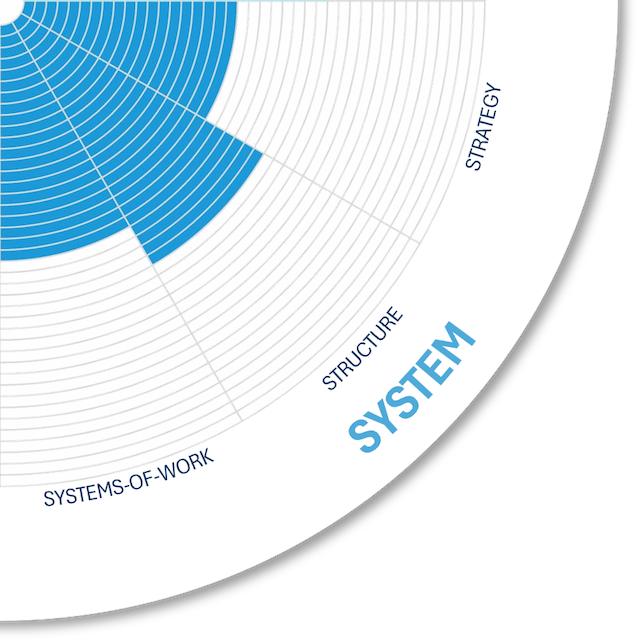
This project was sponsored by a corporate partner of the charity. Verena MacLean and Brent Sheridan were engaged to conduct a diagnostic and provide recommendations. The work focused on understanding structural, cultural, and behavioural factors affecting performance, specifically through the lens of C4AT’s 4 Quadrants, with emphasis on Quadrant 4 (System) and its integration with mindset, behaviour, and culture.
Using Requisite Organisation principles, the team analysed work systems and structural alignment:
- 24 roles were reviewed via structured interviews, examining role complexity, accountability, and relationships, both vertical and horizontal.
- Findings were validated with each individual’s manager to assess fit-for-purpose design and alignment to strategy.
Post-analysis Insights
Leadership and Strategic Misalignment
- The Director was empowered by the CEO to lead a critical function underpinning the organisation’s financial sustainability.
- However, strategic focus was compromised by operational drag—only one of the seven direct reports was operating in Practice work (responsible for systems, processes, and continuous improvement).
- The Director was pulled into operational issues due to underperformance below, limiting strategic thinking.
- High autonomy in several roles blurred boundaries, and some individuals appeared overwhelmed or reactive.
Role Compression and Capability Gaps
- A mismatch in Unique Value Add (UVA) across layers created compression—particularly in Sales and Loyalty—leading to workflow confusion and personality-based execution instead of clear accountability.
- Retail, while high-performing, had expanded its remit significantly, raising sustainability concerns.
- The Manager Once Removed function was missing, undermining long-term development and coherence.
Dysfunctional Work Systems and Delivery
- There was no consistent or documented process for executing marketing campaigns.
- Confusion was widespread over decision rights—multiple people claimed ownership of content, concepts, and delivery.
- The attempted shift to Agile and Human-Centred Design was uneven and poorly integrated; Waterfall persisted in some teams, exacerbating fragmentation.
- There was a clear need for embedded project coaching and a shared delivery model to reduce friction and improve cross-functional flow.
The Solution
A coordinated program of workshops, coaching, and structural alignment was delivered to address the core issues identified in the diagnosis.
Workshops focused on:
- Clarifying roles, accountabilities, and systems of work—ensuring Practice work was embedded and aligned to the appropriate level of thinking.
- Defining the value chain for customer experience and communication—clarifying cross-functional accountabilities.
- Developing accurate and relevant position descriptions to support structural clarity.
- Building shared narratives to align the team around purpose and delivery.
- Surfacing underlying mindsets and Immunity to Change that were blocking adaptation.
In parallel, targeted interventions included:
- Establishing a Social Contract within the team to rebuild trust and shared expectations.
- Coaching for managers to support them in leading change effectively.
- Executive coaching for the Director—focusing on leadership style, internal politics, and the transition to leading within a charitable context.
- Introducing and reinforcing Manager Once Removed accountabilities to strengthen oversight and role clarity across layers.
- Communicating changes clearly across the organisation, highlighting areas of cross-functional collaboration and applying the new operating principles organisation-wide.
Conclusion & Takeaways
The analysis and insights gained enabled a clear focus and prioritisation of interventions, aligned with the organisation’s intent. Crucially, the work integrated behaviours, mindsets, internal politics, and culture, alongside changes to structure and roles.
Too often, restructuring or organisational transformation focuses solely on role numbers and financial implications. While addressing cost realities, such efforts can fall short if not combined with the right decision-making capability (level of thinking), collaborative behaviours, adaptability, and a culture of trust. Without this integration, structural change rarely delivers lasting efficiency or effectiveness. Ways of working can become either too rigid (bureaucratic) or too loose (directionless), prompting further rounds of “re-structuring”—what is often described as "moving the deckchairs on the Titanic".
By addressing these dimensions, the Director was able to clarify work, strengthen relationships within the team, and enhance his reputation across the organisation, all while consistently meeting high expectations for revenue generation.
Focusing on the Practice roles allowed him to recruit capable managers and cascade clear accountabilities throughout the function. Systems-of-work and project management models were made fit for purpose and applied consistently.
This, in turn, enabled the Director to raise his focus to longer-term strategy and market opportunities.
By recognising and addressing internal politics and resistance, he was able to reposition himself effectively with both peers and the CEO.